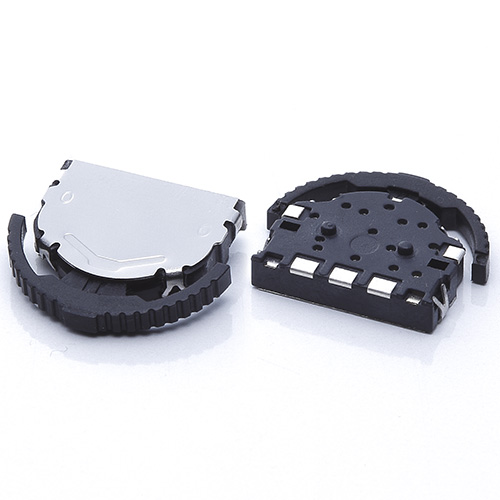
A "push lever switch" typically refers to a mechanical switch with a fan-shaped trajectory or appearance. Its core feature is that the operating handle or knob moves along an arc path to connect or disconnect the circuit. This type of switch is commonly found in devices that require multiple settings or are in space-constrained environments.
Main features and applications:
Structure and Operation: The contact system of the push lever switch is designed to switch along the sector angle. Users select different levels (such as "off", "low", "medium" and "high") by rotating the knob or moving the lever. Its movement trajectory is sector-shaped. This design facilitates multi-level control and is intuitive to operate.
Common Applications:
1. Household Appliances: Used in air conditioners, fans, heaters, and other equipment to control fan speed levels (e.g., cold, warm, hot) or switch modes. For example, some air conditioner fans use push lever switchs to select different combinations of electric motors and heating resistors to achieve different power outputs.
2. Automotive Control: In automotive air conditioning systems, push lever switchs are commonly used to adjust airflow direction or volume, such as controlling the opening angle of air vents.
3. Industrial Equipment: In instruments or control panels requiring precise adjustments, push lever switchs are used to switch sensors, signal sources, or operating modes.
Differences from other switches:
1. Difference from rocker switches: Rocker switches (or rocker switches) achieve on/off switching by pressing up and down the "rocker"-shaped handle. They typically only have two positions, "on" and "off," and are mostly used for power control in household appliances. push lever switchs, on the other hand, are rotary multi-position switches with more complex functions.
2. Relationship with rotary switches: a push lever switch can be regarded as a special form of rotary switch, whose rotation angle is limited to a sector range (such as 0°–120°) rather than continuous 360° rotation.