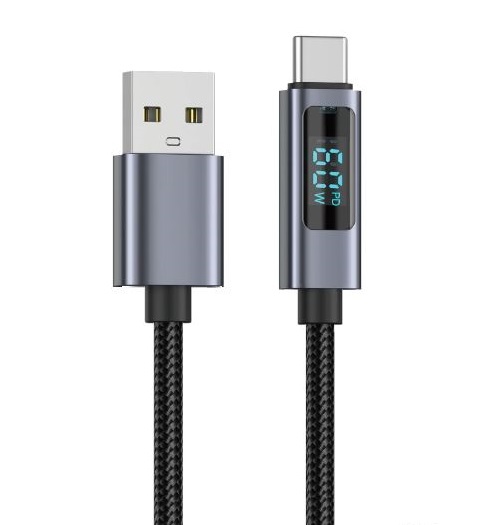

(I)Features of Digital Display Fast Charging Cable
1. Fast charging: The digital display fast charging cable adopts more advanced charging technology, which can achieve faster charging speed and effectively shorten charging time.
2. Digital display: The digital display fast charging cable is equipped with a digital display screen that can display the charging current and voltage in real time, allowing users to clearly understand the charging status.
3. Safety performance: The digital display fast charging cable adopts more advanced safety technology, which can effectively prevent overcharging, overcurrent, short circuit and other situations, and protect the safety of users and equipment.
(II) Differences between digital display fast charging cables and ordinary cables
1. Charging power and speed
Digital display fast charging cables: Typically support high power outputs of 60W, 100W, or 240W, and have a built-in E-Marker chip that automatically negotiates with the phone and charger to achieve maximum charging efficiency.
Standard cables: Most only support standard charging from 5W to 15W, with current limits typically at 2.4A or 3A.
2. Real-time wattage display
Digital display fast charging cable: The screen on the connector directly displays the device's current charging power, making it easy to confirm whether it has entered fast charging mode (for example, the numbers will jump significantly during fast charging).
Standard cable: Has no display panel; users can only judge the charging speed through the charging icon on their phone or by purchasing additional equipment.
3. Safety and Materials
Digital display fast charging cable: The internal wire diameter is thicker to reduce resistance, and the outer layer is often made of wear-resistant braided wire or heat-resistant material. Some have overvoltage protection.
Standard cable: The internal wire core is thinner, and it is prone to overheating when subjected to high current for extended periods.
4. Data transmission
Digital display fast charging cable: Equipped with complete data cable cores, supporting data transfer speeds of 480Mbps and above (some support up to 10Gbps or 20Gbps).
Standard cable: Some inexpensive standard cables on the market may be "charging-only cables," omitting data transfer functionality.