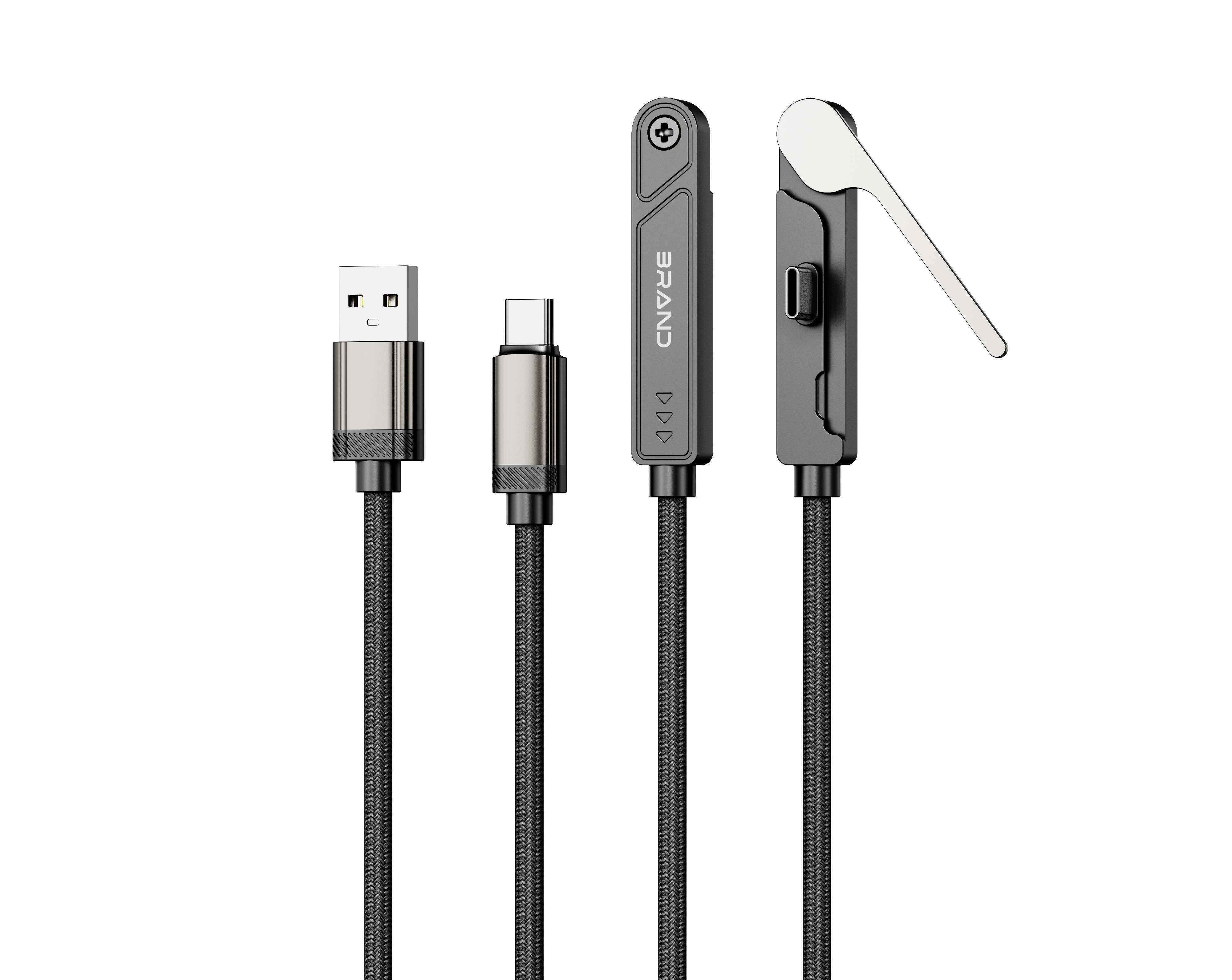
The foldable-stand charging cable is an innovative digital accessory that integrates data transmission, fast charging, and a phone stand into one unit. By ingeniously combining a standard cable with a foldable stand structure, it addresses the common frustration of being unable to comfortably watch videos, make video calls, or play games while charging, thereby enabling a convenient "charge-and-use" experience. Through this smart design innovation, the product solves a practical everyday pain point, serving as a useful tool to enhance one's digital lifestyle.
Core Design and Functional Features
(I) Integrated Foldable Stand Structure
Its most distinctive feature is a foldable mechanical structure integrated into the cable connector or a specific section of the cable itself; with a simple unfolding action, the charging cable transforms into a stable stand for your mobile phone.
1. Multi-angle adjustment: Most products support switching between landscape and portrait modes, while some high-end models feature 360-degree rotation or multi-angle hovering capabilities, catering to various use cases such as navigation, streaming, and video conferencing.
2. Stable Support: The base of the holder typically features anti-slip pads or a weighted design, ensuring the phone remains stable and wobble-free when placed on a desk or in a vehicle.
(II) High-Efficiency Fast Charging Performance
Foldable stand charging cables generally support high-power fast-charging protocols to meet the high energy demands of modern smartphones and tablets.
1. High-power support: Mainstream products support fast-charging power ranging from 66W to 240W and are compatible with major fast-charging protocols such as PD (Power Delivery) and QC (Quick Charge).
2. Low-temperature charging: High-quality products feature a low-impedance design and incorporate technologies such as Gallium Nitride (GaN), enabling high-speed charging while effectively controlling heat generation to protect battery health.
(III)User-friendly cable design
To enhance the user experience, these types of charging cables have undergone numerous optimizations in terms of materials and design.
1. Elbow design: Many models feature an L-shaped or 90-degree elbow connector; particularly in in-vehicle settings, this prevents the cable from pressing against the hand, allows for more natural cable routing, and reduces strain and wear on the port.
2. Durable Materials: The cable body typically features high-density nylon braiding or TPE material, offering resistance to stretching and bending to effectively prevent breakage or damage during daily use. Thickened copper cores are generally used internally to ensure stable current transmission.
3. Flat or soft cable design: Some products feature a flat design that is not only comfortable to the touch but also easy to store and resistant to tangling.