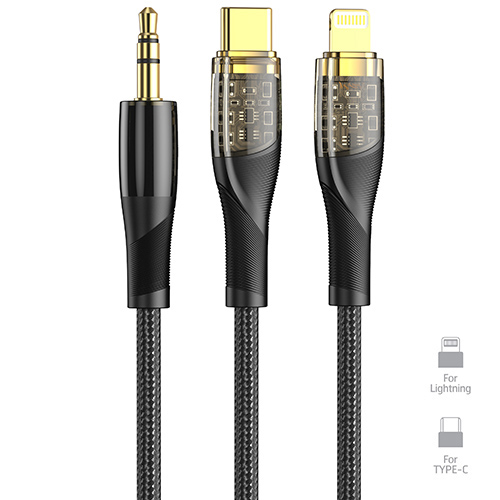
(I) What is an audio adapter cable?
An audio adapter cable is a type of cable used to connect devices with different interface specifications or signal formats. Its primary function is to overcome interface limitations between devices, enabling the seamless transmission of audio signals between audio output devices (such as mobile phones, computers, and musical instruments) and input devices (such as headphones, speakers, and mixers) that would otherwise be incompatible for direct connection.
(II) Common Types of Audio Interfaces
The two ends of an audio adapter cable typically consist of a combination of the following common interfaces:
1. Analog Audio Interfaces
3.5mm (TRS/TRRS): The most common headphone jack. TRS (3-pole) supports only stereo audio; TRRS (4-pole) adds support for microphone input.
6.35mm (1/4-inch): Commonly found on professional audio equipment, electronic keyboards, electric guitars, and amplifiers.
RCA (Phono): Typically appears in red and white pairs (red for the right channel, white/black for the left channel); widely used in home audio systems, televisions, and amplifiers.
XLR: A 3-pin professional balanced interface commonly found on professional microphones and studio equipment; offers excellent noise rejection capabilities.
2. Digital Audio Interfaces
USB-C / Lightning: Standard interfaces for modern smartphones and laptops. Adapters of this type typically feature a built-in DAC (Digital-to-Analog Converter) chip that converts the digital signal from the device into an analog signal for the headphones.
Optical (Toslink) / Coaxial: Used in high-end home theater systems to transmit high-resolution digital multi-channel audio.
(III)Common Application Scenarios for Adapter Cables
|
Adapter cable type |
Before upgrade (Output) → After upgrade (Input) |
Key application scenarios |
|
USB-C to 3.5mm |
Mobile Phone / Tablet → Standard 3.5mm Wired Headphones |
Allow new phones that have removed the headphone jack to continue using old headphones. |
|
3.5mm to RCA (1-to-2) |
PC / Mobile Phone → Home Stereo Active Speakers |
Output music from a personal device to the living room's large audio system for playback. |
|
3.5mm to 6.35mm |
Standard Headphones → Professional Amplifier / Integrated Amplifier / Electronic Keyboard |
Allows standard headphones to be plugged into professional musical instruments or audio equipment for monitoring. |
|
XLR to 6.35mm |
Professional Microphone → Audio Interface / Mixer |
Equipment stringing for stage performances or recording studios. |
(IV) Key Points for Selecting Audio Adapter Cables
1. Pay attention to the number of poles of 3.5mm (TRS vs TRRS):
If you need to use the microphone or in-line controls on your headphones, you must choose a TRRS (4-pole) adapter cable. If you only intend to listen to music, a TRS (3-pole) cable will suffice.
2.Chip Specifications (for USB-C / Lightning adapter cables):
The built-in DAC chip directly affects sound quality. It is recommended to choose a cable that supports a decoding rate of 24-bit/96kHz or higher for greater audio fidelity.
3.Cable Material and Shielding:
Conductor: Oxygen-free copper (OFC) or single-crystal copper offers superior conductivity, helping to reduce signal attenuation.
Connectors: Gold-plated connectors effectively prevent oxidation and avoid the "crackling" noise associated with poor contact after prolonged use.
Outer Sheath: Braided cabling is more resistant to pulling and less prone to tangling than traditional PVC sheathing.
4.Balanced and Unbalanced Signals:
Professional audio equipment often uses XLR or TRS connectors to transmit balanced signals and eliminate noise. When using adapters, it is important to ensure the cables support balanced transmission; otherwise, noise can easily be introduced during long-distance transmission.
(V)Summary
Although compact in size, audio adapter cables serve as a crucial bridge for resolving device incompatibility issues. When selecting one, the most important steps are identifying the interface types (male or female) at both ends and determining whether microphone functionality is required. For smartphone users, choosing an adapter equipped with a high-quality DAC chip helps ensure that musical details are preserved without distortion.